Preterm Birth Happens at Low Risk, Too
1 in 10 babies are born too early. Half of them in seemingly low-risk pregnancies. Preterm birth is the leading cause of NICU stays and infant mortality in the U.S. Many women who experience a preterm birth had no prior risk factors or underlying conditions. No warning signs. Today’s standard prenatal care may not detect your risk for preterm birth (delivery before 37 weeks) before symptoms appear.

Today’s standard prenatal care may not detect your risk for preterm birth (delivery before 37 weeks) before symptoms appear.

Every day counts
The last weeks of pregnancy matter more than most realize.
Babies born even a few weeks early can face significant challenges with breathing, feeding, temperature regulation, and long-term development.
The impact doesn’t stop at the hospital: preterm birth can carry long-term emotional and financial weight for families, too.
PreTRM® determines your individual risk for preterm birth.
The PreTRM test is a simple finger prick blood test, taken between weeks 18 and 21 of pregnancy, that measures proteins in your blood associated with preterm birth. The result gives you and your provider something that hasn’t existed before: your personal risk of preterm birth for this pregnancy, information that you can use together to lower the chances of an unexpected early delivery.

Start a conversation
Work with your doctor to reduce your chances of preterm birth
Your doctor is your best resource to raise questions about preterm birth, understand your own risk factors, and decide whether the PreTRM test is right for you. Our discussion guide can help you start that conversation with confidence. It covers what the PreTRM Test is, how to ask about it, and what to expect from the process.
Get the Discussion Guide
Download it, print it out, save it to your phone, or text it to yourself before your next appointment to start the conversation with your provider.
Coverage & cost
We believe every pregnant woman should have access to this information.
Sera is actively working with private and government insurance programs to expand coverage for the PreTRM test. If your insurance doesn’t cover the test, financial assistance is available if you are eligible. In addition, interest-free monthly payment plans are available for any out-of-pocket costs.
Ask your health plan to cover PreTRM
Coverage is expanding and your voice makes a difference. Download the template letter and send it to your insurer or state Medicaid agency — it takes just a few minutes and helps expand access for pregnant women everywhere.r pregnant women everywhere.
Ready to find out whether you’re at risk for preterm birth?
Skip the wait until your next doctor’s appointment and request the test today .
It just takes a few minutes. You can request the test online and we’ll ship a kit directly to your home, with everything you need for your simple finger prick blood collection, return label included.

1. Talk to your doctor or request the test online.

2. Take a finger prick blood test between weeks 18–21 of pregnancy.

3. Receive information on your individual risk and guidance on next steps.
Is PreTRM right for me?
Most women in early pregnancy qualify.
The PreTRM Test is right for you if:
- You are no further than 21 weeks into the pregnancy
- You are carrying one baby
- You are not currently showing signs of preterm labor
- You are not on progesterone therapy after the first trimester
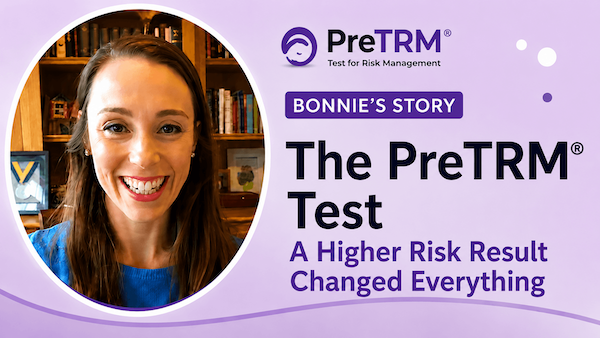
Hear Bonnie’s
PreTRM Story
What moms are saying about PreTRM
As a result of the weekly check-ins & overall care management, I was well-informed and empowered to advocate for myself and my baby.
Bonnie

After my PreTRM Test results, I felt more at peace. I wasn’t as anxious about whether I would make it to full term. I could focus on taking care of myself and my baby.
Anna
The PreTRM Test was quick, but what it gave me was much more – answers and a plan. When I learned I was at higher risk, my care team immediately put steps in place. Instead of waiting and hoping, we acted.
Naomi

Want to learn more?
Most pregnant women are candidates for the PreTRM Test. PreTRM can be used to identify your risk of preterm delivery if you:
- The baby has no confirmed or expected genetic condition or disorder that is associated with shortened gestation
- Are 18 years old or older
- Are pregnant with a single baby (not twins, triplets, or other multiples)
- Are not currently showing signs of preterm labor
- Are not on progesterone therapy after the first trimester of your pregnancy
If you would like to find out if you qualify for the PreTRM Test, speak with your healthcare provider early in your pregnancy.
The PreTRM Test is a newer test, and many providers are still becoming familiar with it, that’s completely normal. You can bring it up at your next prenatal visit and let your doctor know you’re interested in learning about your individual risk for preterm birth. We have resources to help start that conversation.
You can also request PreTRM directly online. Once ordered, Sera’s customer support team will ensure your results go directly to your provider so they can be part of your care plan.
If your doctor ordered the test, your results will be sent to them in an average of 7 business days. They will communicate your results to you.
If you ordered the test online, five days after receiving your sample at our lab, we will send you an email notification to access your results in the PreTRM Portal and share them with your healthcare provider.
If you learn that you are at a higher risk of delivering early, your doctor will work with you to adjust your obstetrical care to plan for this possibility.
You should pay close attention to the changes in your body throughout your pregnancy and be alert to the signs and symptoms of premature labor.
We believe cost should not be a barrier to information that can help you deliver a healthy baby.
With or without insurance, our Customer Support Team is ready to help.
We have financial support options to help those with higher than expected out-of-pocket cost including a patient assistance program, prompt pay discount, or interest-free monthly payment plan options.
You may receive an explanation of benefits (EOB) from your insurance company. This is not a bill. We will work with you and your insurance company to manage the appeals process.
*The amount you pay for PreTRM can depend on a number of factors, including the type of insurance you have, and even the level of coverage your insurance may provide.
Call: (801) 990-6605
Email: billing@pretrm.com

Learn more
How Can I Get the PreTRM Test?
Request the PreTRM Test
There are two ways to get PreTRM. You can request the test from your current healthcare provider or you can request the test online.