Knowing if your patient is at increased risk of delivering prematurely gives you and your patient the power to take informed actions to address the risk. With the PreTRM® Test, you can identify patients at higher risk for a spontaneous preterm birth that would have been missed with traditional screening methods. Studies have shown that focusing care on these patients can improve outcomes.

Multiple studies demonstrate the impacts of the PreTRM® Test-and-Treat strategy 1,2
- Enhanced Screening: Screen singleton pregnancies lacking traditional clinical risk factors with the PreTRM® Test
- Personalized Medicine: Target those with higher risk for preventive treatment
- Improve Outcomes: Deliver healthier babies by increasing gestational age at birth to reduce morbidity, mortality, and time spent in the hospital
Reduce the impacts of preterm birth
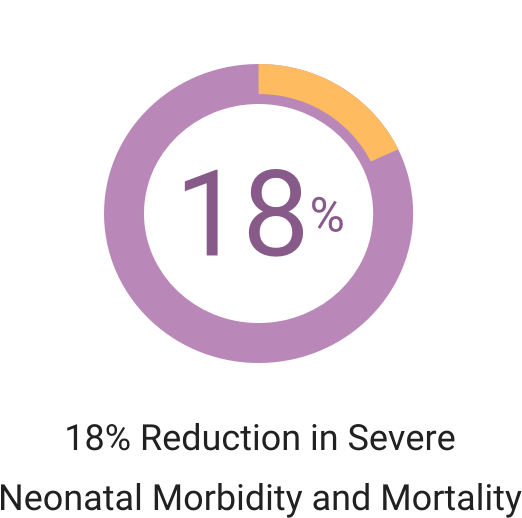
The AVERT PRETERM Trial demonstrated that applying interventions for patients with a higher risk result from the PreTRM Test can reduce adverse neonatal outcomes. There was a 2.48-week increase in gestational age at birth for patients who delivered before 32 weeks. Additionally, neonates had an 18% reduction in severe neonatal morbidity and mortality and an average of one-week reduction in the time a baby stays in the hospital.
Interventions Used in the AVERT PRETERM Trial for Patients at Higher Risk of Spontaneous Preterm birth
- Care management ( twice-weekly nursing contacts to monitor medication compliance and symptom development)
- Aspirin 81 mg daily
- Progesterone 200 mg intravaginally daily
Case Study: The Value of the PreTRM Test Score in Preventing Premature Birth
Dr. Phelps Sandall, MD discusses a 26-year-old patient whose higher risk of premature birth was identified through the PreTRM Test. The ensuing vigilance over her pregnancy prevented a potential tragedy through a preterm birth management strategy.
Watch Our Video on The Value of the PreTRM Test Score in Preventing Premature Birth

What our Video: Case Study Preventing Spontaneous Preterm Birth and Getting to 30 Weeks
References
- Matthew K. Hoffman, Carrie Kitto, Zugui Zhang, et al. Neonatal outcomes after proteomic biomarker-guided intervention: the AVERT PRETERM TRIAL. medRxiv 2023.09.13.23295503; doi: https://doi.org/10.1101/2023.09.13.23295503
- C. Andrew Combs, John A.F. Zupancic, Mike Walker, Jing Shi. Prediction and Prevention of Preterm Birth: Secondary Analysis of a Randomized Intervention Trial. J Clin Med 2023;12(17). DOI: 10.3390/jcm12175459.
Request the PreTRM® Test
Haven’t had the PreTRM® Test yet? Talk with your healthcare provider or you can have a kit shipped to your home.